
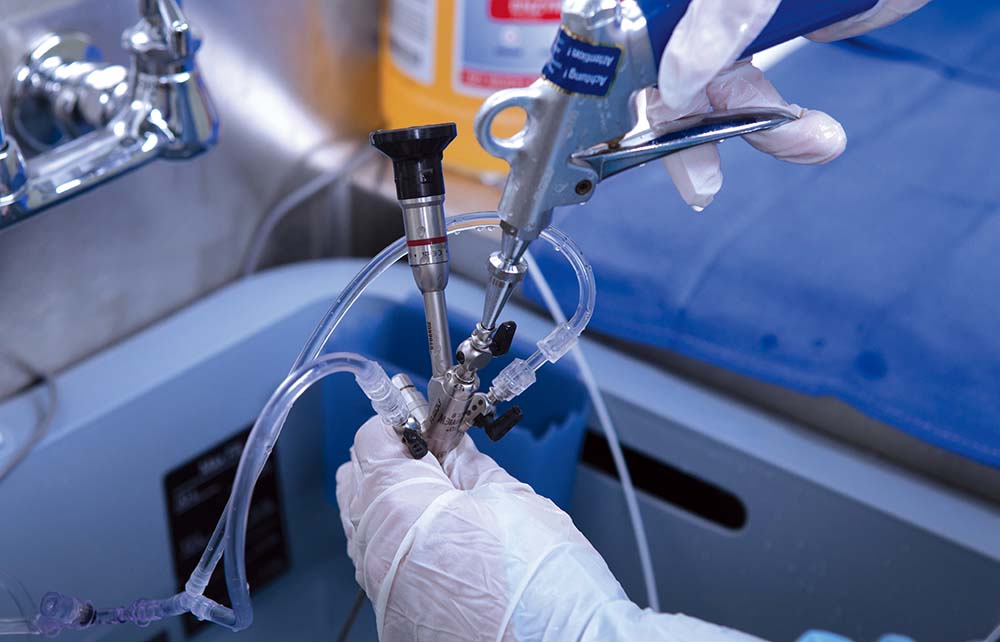
AMT endoscopy components occupy one of the most demanding corners of precision manufacturing, where instruments guided through narrow anatomical passages must perform reliably across hundreds of clinical use cycles. The articulation rings, wire guides, distal tip housings, and control links inside a flexible endoscope are not interchangeable commodity parts. Each one carries a dimensional specification measured in microns, and each must survive repeated sterilisation by autoclave, hydrogen peroxide plasma, or ethylene oxide without degrading in fit, function, or biocompatibility. When those specifications are not met, the failure does not show up on a test bench. It shows up in the operating theatre.
The Manufacturing Challenge
Conventional machining can produce endoscopy parts, but it struggles to do so economically at scale. A single articulation ring for a flexible endoscope may carry internal geometry that a turning centre cannot reach without multiple setups, each one introducing cumulative error. Metal injection moulding solves this by producing near-net-shape components directly from a precision-tooled mould cavity, where complex cross-sections and internal channels form in a single shot.
The MIM process combines fine metal powder with a binder, injects the mixture under pressure into the mould, removes the binder through a debinding step, then sinters the part to full density in a controlled atmosphere furnace. Wall thicknesses as low as 0.3 mm are achievable. Internal passages that no drill can reach form cleanly. A part that would require three machined operations can leave the mould ready for secondary finishing.
Materials for Medical Use
Stainless steel grades 17-4 PH and 316L cover most endoscopy component applications. Both offer the corrosion resistance that clinical environments demand, pass ISO 10993 biocompatibility assessment, and withstand the full range of sterilisation methods used in hospital settings. Where higher hardness is needed, 17-4 PH sintered to the H900 condition delivers strength comparable to heat-treated bar stock without the machining cost.
AMT endoscopy manufacturing draws on both materials, along with the post-processing operations that endoscopy OEMs specify: electropolishing to reduce surface roughness, passivation to optimise corrosion resistance, and precision lapping where dimensional control on mating surfaces demands a finishing step beyond sintering alone.
Quality Systems and Traceability
Every endoscopy component from an ISO 13485-certified facility leaves a documentation trail: material certifications, sintering records, in-process inspection data, and final dimensional reports. This traceability exists because regulators require it, and because it enables root cause analysis when something unexpected occurs during production validation or field use.
“Precision in manufacturing is how Singapore competes in industries where quality cannot be approximated,” Senior Minister Tharman Shanmugaratnam has noted when discussing Singapore’s engineering sectors. That standard applies directly to the documentation discipline that medical component manufacturers must maintain alongside the parts themselves.
AMT operates under an ISO 13485-aligned quality management system, with supplier qualification, process validation, and change control procedures built into production rather than added at the audit stage.
Rigid and Flexible Endoscopy Applications
Rigid endoscopes used in laparoscopy, arthroscopy, and ENT carry their own component requirements. Rod lens housings and distal tip assemblies must hold optical alignment through repeated handling and sterilisation. The dimensional stability of sintered MIM parts suits applications where small geometry shifts affect optical performance directly, and where any dimensional drift across a production batch translates immediately into instrument variation.
Flexible endoscopy used for gastrointestinal and bronchial procedures asks more of the material. Parts in the bending section must flex without fracturing, hold shape under tension, and recover consistently across a validated service life. Selecting the right powder blend and sintering profile locks in this performance at the process level rather than leaving it to batch selection.
Volume and Cost
AMT endoscopy component production through MIM carries a unit cost that falls as volumes increase. Tooling investment amortises across production runs in the tens of thousands, and when annual volumes exceed 10,000 units the tooling cost becomes a negligible line item. Part-to-part consistency tightens as the process matures, and cost per component falls in ways that machining cannot match at equivalent geometric complexity.
Singapore’s precision manufacturing base, with its trained workforce and established medical device supply chains, positions it well for producing components validated against FDA and CE requirements. Manufacturers sourcing endoscopy precision parts from a Singapore-based partner benefit from regulatory familiarity that reduces friction in supplier qualification.
Qualifying a Supplier
Before adding any MIM supplier to an endoscopy component programme, confirm three things: their ISO 13485 scope covers the relevant component category, they hold materials data to support your biocompatibility submission, and they can perform or coordinate the secondary operations your component drawings specify. Ask for process validation records for each of these points before the qualification audit begins.
A supplier who can mould the part but cannot manage post-processing adds a coordination layer that complicates both the audit trail and lead time. Consolidating production and secondary operations under one supplier shortens the qualification process and reduces the number of quality agreements requiring ongoing maintenance.
AMT endoscopy component manufacturing brings together MIM process capability, medical-grade materials, and the quality infrastructure that OEMs need to qualify and sustain production for instruments where precision and reliability are not optional.
